The Eleventh Five-Year Plan on Chinese Textile Industry
Source: CCPIT TEX Date: 2006-11-20
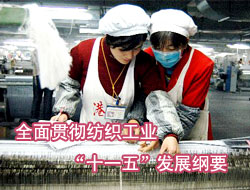
Chinese textile industry, a traditional pillar in the national economy and a very competitive sector for its comparative advantage, displays its elegant demeanor in international market. It has been playing a very important role in aspects of employment, farmers’ income, capital accumulation, export earnings,boosting market prosperity, escalating urbanization, pushing forward the related industrial sectors and facilitating regional economic growth.Nevertheless, the structural problems that have massed up for a long time are now prominent despite a rapid development in its textile industry. To challenge the new situation of national economy, social development as well as the new changes of international textile trade system, are all the more urgent tasks during the Eleventh Five Year Plan period,to implement science—oriented concept and to adhere to self-initiated creativity for a real shift of economic growth model.
To carry out‘the Eleventh Five-Year Plan Guideline for National Economy and Social Development’, the State Development and Reform Commission (SDRC), together with China National Textile and Apparel Council (CNTAC),has mapped out‘the Eleventh Five-Year Plan Guideline for Textile Industry in China’in an active effort to push forward scientific and technological progress,focusing on indigenous innovation for a shift to a new growth model, upgrading & optimizing industrial structure,striving for a complete, coordinated and sustained development in Chinese textile industry.
In the textile blueprint for the next five years,the guideline, direction and focal task are defined in a clear-cut term based on a thorough analysis and elaboration on crucial issues, domestic and international environments and industrial development trend. Forecasts are made with respect to production capacity and structural target with more specific indexes that have to be fulfilled for energy-saving and environmental protection. In a nutshell, the main destination is set for building up a textile powerful country by taking a new route of industrialization,a strategic goal in the years to come. To target it,one must be fully aware of the situation and strike out a clear thought, the right direction and clarify what must be emphasized. With this, the leading market performance can be guided in such an active way as to boost this industry in a complete,well-balanced and sustained growth.
Achievements in the Past Tenth Five Year Plan Period
1/ Rapid and Consistent Growth
In 2005, the sales income of the textile enterprises (above designated scale and size) totaled 1979.4 billion Yuan, up by137.4% against 2000, all annual averaged growth of 18.9%, and the industrial added value reached 499.9 billion Yuan, up by 125.6%, an annual averaged growth of 11.7%.The total fiber processing volume arrived at 26.9 million tons, up 97.8%, all annual average of 14.6%. The number of textile enterprises (above designated scale and size) grew from 19,400 in 2000 to 36,000 in 2005 while the employment in the same level of enterprises increased from 7.38 million people in 2000 to 9.78 mⅢion in 2005,up 32.5%, an annual average of 5.7%. If all the textile enterprises, large or small,are taken into an account, the total employment in this industry comes up to 19.6 million people.
In the main product lines, the yarn production flew up to 14.4 million tons,up118.2%, an annual average of 16.9%, and the man—made fiber production reached 16.29 million tons, up 134.2%, an annual average of 18.6%. Chinese production in man-made fiber, cotton yarn, cloth, wool fabric,silk products, apparel a11 come to the first place in the world, and the fiber processing vo1ume grew from 25% in 2000 to 36%in 2004 in a global market share to continue keeping the 1argest standings in the world textiles and apparel production.
2/ Economic Performance & Profits Stably Improved
Despite intensified international trade disputes,rising oil price, value increase in RMB and export taxes, the textile industry still maintained a good momentum in its economic performance. In 2005, the total tax and profit in the textile enterprises (above-designated scale and size) summed up to 123.1 billion Yuan, and me total profit realized 69 bil1ion Yuan, a growth of 104.6% and 133.5% respectively against 2000.
The total assets Of the textile industry amounted to 1,601.5 billion Yuan ($200 billion),up 63.6%against 2000, the equity/debt ratio is 60.3%, 5.2 percentage point down, the production/sale ratio is 97.8%, 0.8 percentage up. The total loss was sliding to 16.9% from 20.2%in enterprises as a whole, and the productivity increased from 34,412 Yuan per person to 51,099 Yuan per person. The cyclic times of flowing assets circulation grew from 1.9 t0 2.5 times, which displayed market vitality and a growing cut-edge competitiveness in the textile industry.
3/ Rapid improvement of technology and equipment
During the‘10th Five—Year Plan’period of time, China textile industry made efforts to restructure the technology with an increasing investment on advanced technical equipment gradually. The 1evel of China textile industrial equipment and technology had been improved to a new height by upgrading and introducing more foreign advanced technologies and equipment. In these five years, the import value of overseas advanced equipment reached 1 8.9 billion USD, accounting for 50% of the total industrial equipment investment value.The domestic suits of equipment in this period almost met the international requirement of the 1990s. In 2004, nearly half of the equipment in the cotton industry measured up to the international level, a rise of 20 percentage points compared with that of the early ‘10th Five—Year Plan’ period. The proportion of combed yarn, knotless yarn, and shuttleless cloth rose from 20%, 40%and 2l% to 25%, 55%and 53% in 2005 respectively. The finishing technology after dying and printing restricted textile industry in upgrading for years, has been strengthened a lot resulting in a huge improvement of the domestic fabrics quality. The export of textiles fabric enlarged for l.4 times five years ago with an annual growth rate of 19%. The self-supply rate of export textiles fabric went up from 50% in the‘9th Five—Year Plan’period to 70%, which was beneficial to build up the industrial competitiveness.
4/ Progress on self-innovation
During the ‘10th Five - Year Plan’ period, both the equipment 1evel and the market share of domestic textile machinery ascended obviously. The production value rate of new textile machinery products ascended from 1 9.1%in 2000 to 25.3%in 2004. The breakthrough of textile machinery technology provided strong safeguard to the alteration of textile technique and the development of new products; meanwhile, the application of self-innovation technology could reduce the investment cost remarkably. The1arge scale suits of PET equipments, of which the annual production capacity could arrive at 150-200 thousand tons, reached the advanced level of international like—products. The investment on thousand—ton units decreased from 85 million Yuan in ‘8th Five-Year P1an’ period to 13 million Yuan in‘9th Five-Year P1an’period, falling down by 85%. Among the 15.62 million tons PET finished in the ‘10th Five-Year-Plan’ period, 75% of which was realized by the technology exploited by China, and the Other 25% relied on foreign technology. The self-exploited technology for producing polyester filament and staple helped the unit-investment decreased by 92% compared with that of the ‘9th Five-Year Plan' period. Recently, the advanced spinning frame among the cotton industrial machinery could be produced by China, and the suits of blowing-carding-drawing units produced by China occupied 65% of the market, which exported more 30 suits accumulatively. The new technology and equipment for digital printing and lignette has already stepped into the time of batch production industrially.
The design and exploitation on new fiber material technology, fabric technology and products has been enhanced significantly so that a series of technology, which could increase the value-added of products, had been spread and applied widely. In 2005, the differential rate of MMF (Man-made fiber) was 31%, rising by nine percentage points compared with 2000. Some self-exploited new types of fiber, such as bamboo pulp fiber, egg albumin fiber, ultra-high-strength high-modulus polythene fiber, polysulfone fiber, the carbon fiber, PTT fiber, aramid fiber 1313, high-performance superfine fiber and so on, per-formed well in the filed of spaceflight, war industry and other industries. The technology of some natural fiber, just likehemp fiber, bamboo fiber and silk promoted the development of textiles fabric and advanced the competitiveness of up-down streams textile industrial chain distinctively.
5/ The structure adjustment of textile industry showed obvious affects
From 2000 to 2005, the textile industry fastened up its industrial upgrading process mainly via having more 'new generational' textile firms, which adopting and developing new technologies and textile equipments. Also, textile materials such as man-made fiber grew quickly too in terms of quantity, its proportion reached to 65% in 2005, which relieved the tension of material supplement.
A significant climb in home textile industry prompted the increase of fiber processing to 760,000 tons in2004, increased of 194.6% at the same period of 2000, and it grew a 31% per year from 2000. Moreover, fiber consumption in garment, home textile and industrial areas took up more share in2004 than 2000, it went from 68:19:13in 2000 to 54:33:13 in 2004.
The capital pluralism has become a major character in Chinese textile industry, and non-private sector grew fast during the eleventh 'fifth year plan'. Amongst above designated sized enterprises, the proportion of non-state owned firms have increased from 80.5%in 2000 to 95.9% in 2005; and sales in-come of the non-governmental sector went up to 90.8% in 2005 from 71.7% in2000, total profit value rose from 76.6%to 99.0%, export delivery value went up to 93.8% from 81.2% in 2000 and the increase rate for employment was 88.0%in 2005 whereas in 2000 it was 64.5%.
6/ Textile exports continued to grow fast
In 2005, Chinese textile and garment exports achieved $117.5 billion; a jump of 121.6% compared to $53 billion in2000 and it was leaping by an average17.2% per year. Chinese textile and garment exports accounted for 24% of the entire world trade value in 2005, via comparison it took 15% in 2000, also, the textile and apparel trade surplus went up from $39.2 billion in 2000 to $100.4billion in 2005, and it ran up by 20.7%in average year by year.
Within the total textile and apparel exports, textile goods weighted up 37.4%in 2005, a 6.6% up from 2000; on the other hand, the quality of garment ex-ports have increased and 40%-50% of clothing exports were mid-high end products. From the perspective of trade mode, in 2000 the general trade method accounted for 55.7% and by 2005 it took up 69.7%; thereinto, general trade in textiles took 72.4% and garment had 68.1%.Furthermore, the main overseas destinations for Chinese textile and garment ex-ports in 2005 were the US, the EU and Japan as they weighted 48% in the sum of Chinese textile and apparel exports, and the total export value to these three countries increased by 133% compared to the same period of 2000.
7/ An increasing industrial centralization
During the Eleventh Five-Year Plan, the textile and apparel industry has been led more and more by the market itself and the centralization of industry has be- come a current trend, where industrial clusters is becoming a dark horse in this field.
In 2004, 21.9% of the sales in- come and 16.3% of export delivery value were added to the national top hundred textile firms out of all above designated sized textile enterprises. In details, the top 50 firms that working in cotton spinning, wool spinning, man-made fiber and textile machinery business achieved a sales income of23.6%, 40.7%, 64.3% and 60.1%respectively, out of the total sales income of all above designated sized textile firms working in the industries above.
The east of China remains to be the major area for textile and garment development, Jiangsu, Zhejiang, Guangdong, Shanghai, Shandong and Fujian these five provinces grasped 80%of the textile and garment firms that are above designated size, as well as 73%of the national employment in textile and garment industry, 82% of the sales pro-duction value, 88% of the export deliv-ery value and finally 90% of the FDI.
Mainly appearing in small towns, led by privately owned small to medium firms and holding expertise in one or two specific areas, those are the characteristics of industrial clusters in the textile and garment industry. For example, the man-made fiber cluster in Xiaoshan, Zhejiang province, fabric cluster in Shaoxing, garment cluster in Donguan, Guangdong province, wool spinning group in Jiangyin, Jiangsu province and so on. Those industrial clusters have shown its competitive potential and positive energy in becoming the most active economic carrier in Chinese textile and garment industry.
8/ Notable progress in utilizing foreign capital
The textile industry opened up and attracted foreign capital comparatively earlier, and has made notable progress in utilizing it. It is one important filed to attract foreign investment. During the period of 'Tenth Five-Year Plan', the total contractual foreign capital invested in the textile industry reached 53.3 billion USD, with an annual growth of 34.1%. 56% was invested in the clothes industry. The foreign investment mainly gathered in the east coast where the textile industry was prosperous. During the time of 'Tenth Five-Year Plan', over 90% of the contractual foreign investment nation-wide was used in Zhejiang, Jiangsu, Shandong, Fujian, Guangdong and Shanghai. In recent years, Jiangxi, Heibei, Hubei and Liaoning in the central region have become the areas that attract lots of foreign investment. Sino-foreign joint ventures, Sino-foreign co-operative enterprise and foreign-funded enterprise hold important positions in textile and clothes export. In 2005, the export value of those three kinds of enterprises totaled 40.3 billion USD, ac-counted for 34.3% in the whole export value of textile and clothes. The exports of textiles were 14.7 billion USD and the clothes were 25.6 billion USD. By means of introducing into foreign investment, advanced technologies and modernized management, they made great contributions to the textile industry in several aspects, including upgrading the level of equipment and technology, lifting up the R&D ability, enhancing the brand development consciousness, driving the ad-justment of industrial structure and expanding exports.
9/ Marked contributions to the national economy and social development
During the time of 'Tenth Five-Year Plan', the textile industry played an im-portant and positive role in the national economy and social development.
First, it met the continuously in-creasing domestic consumption needs. From 2000 to 2005, the urbanization rate has been lifted up from 36% to 43%.Urban per capita clothes consumption rose by 75.3% from 500 Yuan to 790Yuan, and rural per capita clothes consumption rose by 46.9% from 96 Yuan to 132 Yuan. When calculated at a com-parable price, in 2005, the average per capita clothes consumption in China was up by 74.2% compared with 2000. The per capita fiber consumption increased from 7.5 kg to 13 kg.
Second, it offered a huge number of job positions to the society. According to the national economy census in2004, the number of employees in legally established enterprises of textile industry accounted for 16.0% in the whole national manufacturing industry. Adding the employee numbers in individual business, the amount of employment in the whole textile industry reached 19.6 million in 2005. Compared with the national employee number in enterprises above designated size from industry, the proportion of employees in enterprises above designated size from textile industry was up from13.3% in 2000 to 14.2% in 2005.
Third, it played an important role in alleviating the pressure caused by the is-sue of 'agriculture, rural areas and farmers'. Among the employees in the textile industry, above 70% were from rural areas. The rural income has been increased above 100 billion Yuan annually, making full use of the important role of Industry nurturing agriculture. In 2005, the consumption of domestic natural fabric was around 7,300,000 tons, which was directly associated with 100 million farmers' livelihood. The development of industrial clustering let thousands of farmers changed their industrial status. It also had great significance to the urbanization of rural areas and the gradually changing of dual structure in urban and rural economy.
Fourth, it contributed an increasing foreign exchange and maintained balanced international payments. In the 'Tenth Five-Year Plan', the exports of textile and clothes added up to 335.2 billion USD favorable balance of trade, which was as 1.6 times as the national favorable balance of trade made in the corresponding period. It has become one important industry to raise foreign exchange reserves.
Fifth, it promoted coordinated development of related industries. According to the statistics of national economy input and output released by National Bureau of Statistics of China, every time the textile industry added one unit in the input, its effect coefficient to the national economy would be 1.25, 25% higher than the average number. It effectively drove the development of related industries including agriculture, transportation, architecture, medical and health, petroleum and chemicals, machinery, logistics and trade.
To be continued